We use cookies to ensure our site functions properly and to store limited information about your usage. You may give or withdraw consent at any time. To find out more, read our privacy policy and cookie policy.
Manage Cookies
A cookie is information stored on your computer by a website you visit. Cookies often store your settings for a website, such as your preferred language or location. This allows the site to present you with information customized to fit your needs. As per the GDPR law, companies need to get your explicit approval to collect your data. Some of these cookies are ‘strictly necessary’ to provide the basic functions of the website and can not be turned off, while others if present, have the option of being turned off. Learn more about our Privacy and Cookie policies. These can be managed also from our cookie policy page.
Strictly necessary cookies(always on):
Necessary for enabling core functionality. The website cannot function properly without these cookies. This cannot be turned off. e.g. Sign in, Language
Analytics cookies:
Analytical cookies help us to analyse user behaviour, mainly to see if the users are able to find and act on things that they are looking for. They allow us to recognise and count the number of visitors and to see how visitors move around our website when they are using it. Tools used: Google Analytics
Share How the NHS uses patient data - Share your views on FacebookShare How the NHS uses patient data - Share your views on TwitterShare How the NHS uses patient data - Share your views on LinkedinEmail How the NHS uses patient data - Share your views link
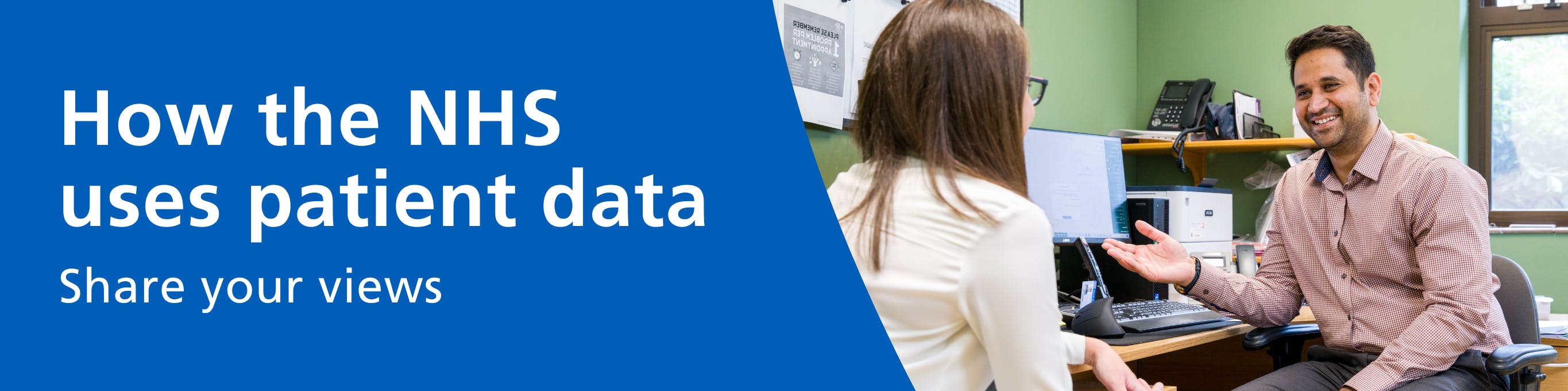
The NHS uses information from patient records not only to support individual care, but also to help plan and improve health and care services for local communities. This can include understanding where demand is highest, identifying health inequalities, and making sure services are designed to meet people’s needs.
We know that how patient data is used matters to people. It is important that it is handled carefully, securely and for clear public benefit. It should be handled carefully, securely and for clear public benefit. That is why we want to understand what people already know, how they feel, and what questions or concerns they may have.
This short survey is anonymous. We are not asking for any personal or identifiable information. Your responses will be used to help shape how we explain the use of patient data in future communications, including the safeguards in place and the choices available to people.
Thank you for taking the time to share your views.
Survey closes Wednesday 4 March 2026.
The NHS uses information from patient records not only to support individual care, but also to help plan and improve health and care services for local communities. This can include understanding where demand is highest, identifying health inequalities, and making sure services are designed to meet people’s needs.
We know that how patient data is used matters to people. It is important that it is handled carefully, securely and for clear public benefit. It should be handled carefully, securely and for clear public benefit. That is why we want to understand what people already know, how they feel, and what questions or concerns they may have.
This short survey is anonymous. We are not asking for any personal or identifiable information. Your responses will be used to help shape how we explain the use of patient data in future communications, including the safeguards in place and the choices available to people.
Thank you for taking the time to share your views.
Share How the NHS uses patient data - Share your views on FacebookShare How the NHS uses patient data - Share your views on TwitterShare How the NHS uses patient data - Share your views on LinkedinEmail How the NHS uses patient data - Share your views link